Historic Images and Photographs of Cabo San Lucas, The Tourist Corridor & San Jose del Cabo, Los Cabos, Baja California Sur.


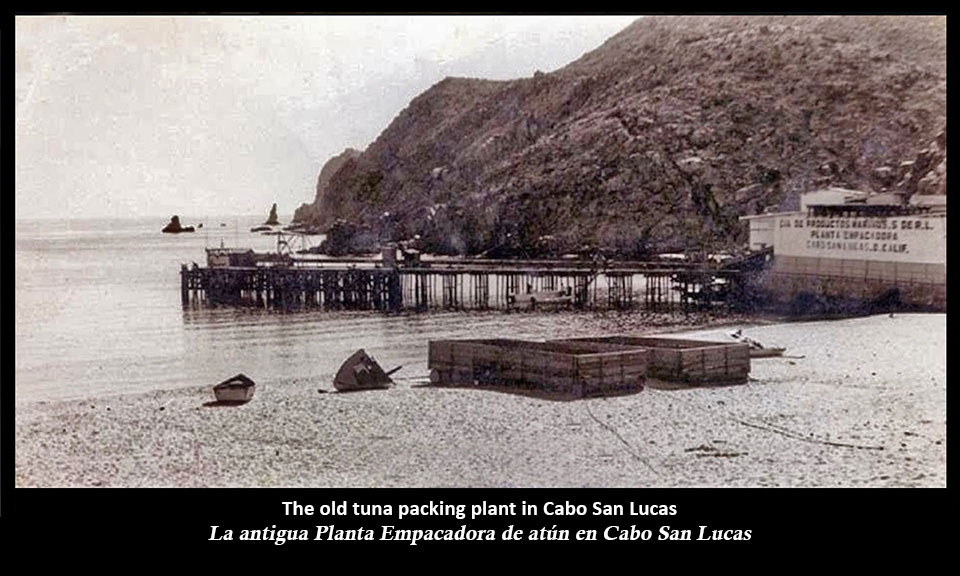
In 1917 an American company established floating plant for the exploitation of tuna, and ten years later the Marine Products Company was established. 1917 – Una compañía estadounidense estableció en 1917 una planta flotante para el aprovechamiento del atún, y diez años después se estableció la Compañía de Productos Marinos. Source: https://raulverdugo.blogspot.mx/2011/08/cabo-san-lucas.html



In this impressive photograph, which was taken at the beginning of the decade of the seventies of the twentieth century, we see the background tuna packer Pando, at the bottom the Finisterra hotel that was his huge beach watching the Pacific.
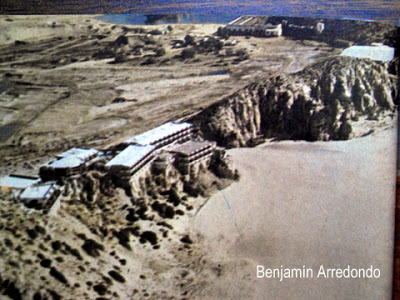 It is indeed surprising to see detail this photograph was taken in 1970, although the date is not confirmed, I guess it will be in that year when it was taken. We clearly see the building occupied by the tuna cannery Pando and the few buildings that were in what is now the tourist marina of Cabo San Lucas, back is a warehouse, maybe it was part of the plant of Don Elias Pando. We reached the pier also served notice to the packing and would later be used for ferry service that existed between this point and Puerto Vallarta. We have been asked as then population centers that now make up the municipality of Los Cabos.
 Source: https://vamonosalbable.blogspot.mx/2012/05/un-vistazo-cabo-san-lucas-en-1970.html


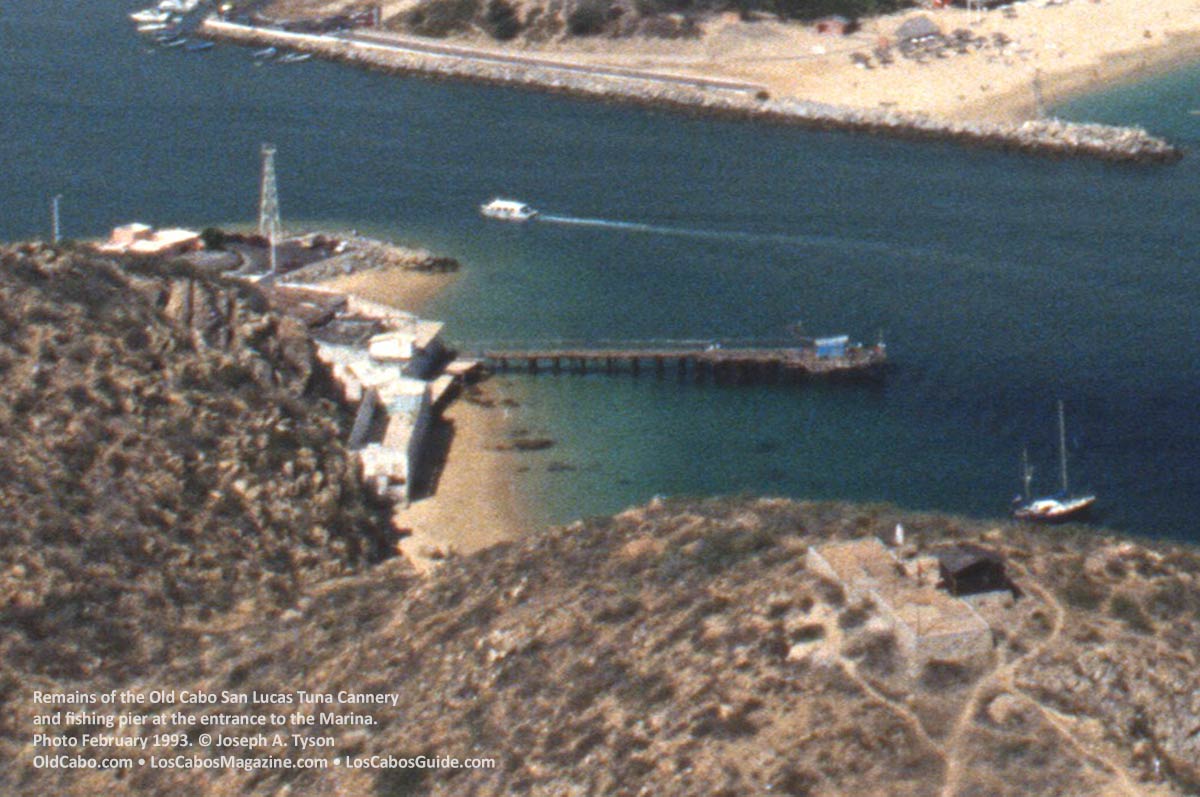
What remains of the old tuna canning plant in Cabo San Lucas is merely a shell of its former self. Nearly destroyed by a hurricane in the 1940’s and rebuilt in the 1950’s the old building stands as piece of local history. The historic Cabo San Lucas tuna cannery in the photo above was built in 1927 and kept in operation until 1980.


The original San José del Cabo Añuiti Mission Church was built in April 8, 1730.


Founded near the southern end of the California peninsula, this was one mission that served one of the reasons for occupying California (to resupply the Manila Galleon on its long return to Acapulco from Asia).
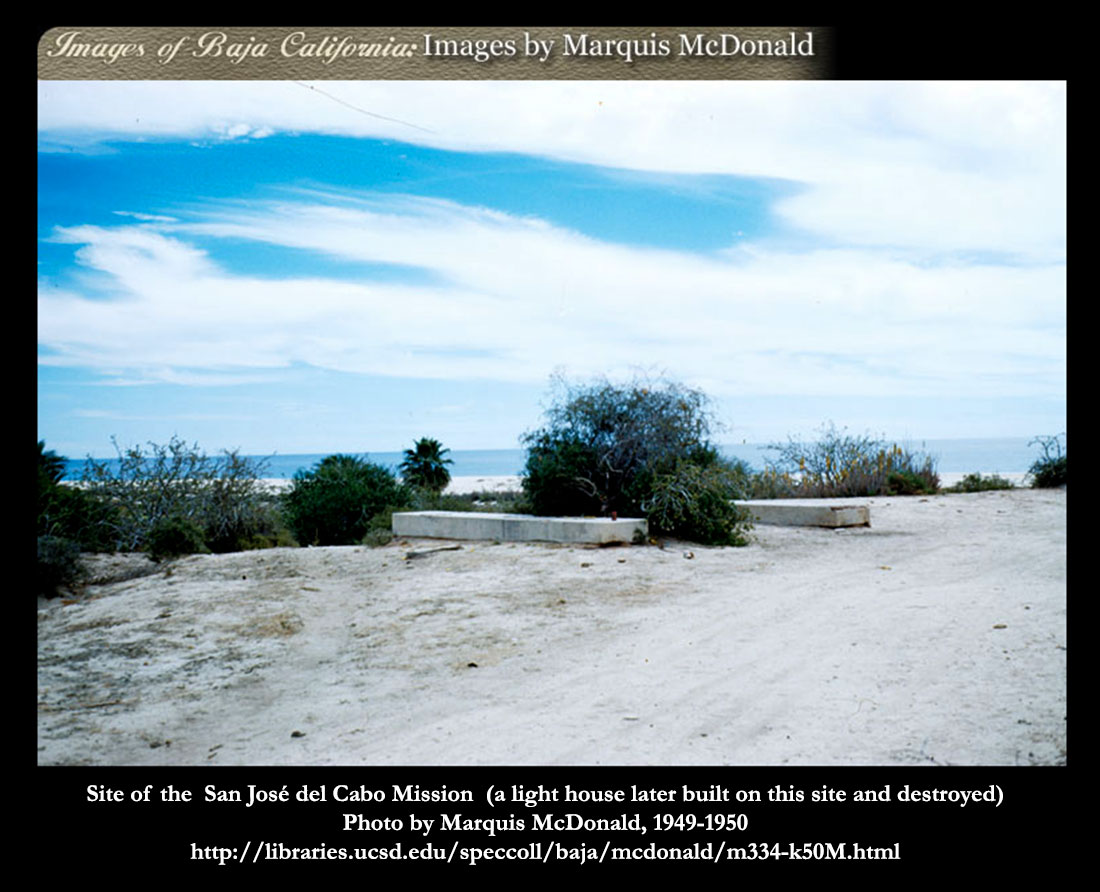
The Pericú Revolt of 1734 destroyed the mission, and over its years, the mission moved locations at least 4 times between the beach and 5 miles inland.
The mission was closed in 1748, and for the next 20 years it was a visita (satellite mission station) of Santiago. It was returned to mission status with the arrival of the Franciscans who replaced the Jesuits after their forced removal.
No ruins remain today at any of the 4 sites, but the modern church in the town plaza is built on the final site.
Marquis Mcdonald identified two of the old mission sites during his excursion during 1949-1950, but there was very little remaining to determine the size or shape. His book, Baja: Land of Lost Missions reports his findings.
Tile mosaic above the entrance doorway shows the murder of Father Tamaral in 1734.
Source: https://historum.com/american-history/83478-missionaries-baja-california-1697-1850-a-2.html


Established in 1730 by Jesuits Father Nicolas Tamaral and Jose Echeverria, the first Mission building was established close to the Estero (Rio San Jose), soon they have to move locations do to a
mosquito infestation the new location was San Jose Viejo.
Constructions at that time were simple adobe structures
with stick and palm roofs and do to storm damage and Pericu Indians sacked and destroying the buildings the Missionaries had to move the mission location on several times. Father Tamaral rebuilt the Mission on the Santa Rosa area.
In 1734 Father Tamaral pronounced against polygamy, this pronouncement caused a rebellion, where the Pericu Indians burned the Mission and during the uprising, Father Nicolas Tamaral was murdered with great cruelty, The Jesuit Fathers left the Baja Peninsula in 1768.
In 1793 the Mission was destroyed by a storm and rebuilt in 1799.
From 1820’s to 1840’s due to wars and the poor conditions of the building the Mission was abandoned in 1840.
In 1932 the actual Mission was built across to the Plaza Mijares, being served by Combodian Missionaries from 1948 – 1986. Actually the Mission of San Jose has been in the Hands of Diocesan Clergy and attended by Father Juvencio Gonzalez.
English Mass: Sunday at 12 Noon
Phone: (624) 142-0064
Email: padrejuve@hotmail.com
From an old website: https://www.cabomission.com/


San José del Cabo Catholic Chruch • Misión de San José del Cabo Anuiti.
Photo June 22, 2015 • Joseph A. Tyson


Mission San José del Cabo was the southernmost of the Jesuit missions on the Baja California peninsula, located near the modern city of San José del Cabo in Baja California Sur, Mexico.The southern cape of the Baja California peninsula had been an often-visited landmark for Spanish navigators (as well as English privateers) for nearly two centuries when a mission was finally established at the Pericú settlement of Añuití in 1730 by Nicolá Tamaral. Initially located near the beach, the station was subsequently moved inland about 8 kilometers.In 1734 the Pericú Revolt broke out, Tamaral was killed, and the mission was destroyed. In 1735–1736, the reestablished outpost was moved back closer to the coast, but it served as a visita for Mission Santiago and as the site of a Spanish presidio. In 1753, San José del Cabo was again moved inland. In 1795, under the Dominicans, the surviving native population of Mission Santiago was transferred to San José del Cabo. The mission was finally closed in 1840.
Today this is the most historical place to get married in Los Cabos with a Catholic ceremony. Have a nice day, Francisco Estrada
https://photoamore.photoshelter.com/
—————